Well Water Testing in BC, and the Septic Checks That Go With It
Buy a rural property in the Fraser Valley and the water supply and sewage system become your job, not the city's. Here is what to test, which records to ask for, and how to build both into your offer.
The short answer
- Test a well at a qualified lab for bacteria (total coliform and E. coli) and chemistry, including nitrate, arsenic and manganese. Clear, good-tasting water can still fail.
- HealthLink BC advises testing for bacteria at least once a year, and for chemistry when a well is finished and then every year.
- Get the driller's log, check the provincial GWELLS database, and order a yield test to see how many litres per minute the well delivers.
- In BC only an authorized person can design, install, repair, maintain or inspect a septic system. Get their inspection, and the Fraser Health records, before subjects come off.
Your well, your responsibility
Fraser Health describes private wells as having minimal regulatory oversight, and HealthLink BC is clear that the owner of a well serving 1 household is responsible for testing it. The Province does not license groundwater used only for household purposes, such as drinking, cooking, sanitation and watering a garden of up to 1,000 m², but it strongly encourages owners to register their wells, at no cost. Wells drilled, altered or decommissioned after February 29, 2016 must be registered in the GWELLS database, so older wells may not appear there.
For a buyer, that means nobody has checked the water for you. The seller may have old results, but well water can change, so order your own. Fraser Health calls lab testing the only reliable way to know whether water is safe, because water that looks clear and tastes fine can still carry bacteria and chemicals.
What to test for, and what the results mean
Ask a qualified lab for a potability test. HealthLink BC points to the CALA directory of qualified labs, and Fraser Health notes that labs generally do not collect samples: they send a kit with bottles and instructions, or you can hire a professional to sample. These are the results that matter most in the Fraser Valley:
| Test | What a problem result means | Guideline |
|---|---|---|
| Total coliform bacteria | The well may need sanitation or physical upgrades, or surface water is getting in | Any detection is a reason to look at the well |
| E. coli | Fecal contamination; the water is not safe to drink | Any detection is an immediate health concern |
| Nitrate | Usually fertilizer, manure or septic; a particular risk for babies and pregnancy | 45 mg/L as nitrate (10 mg/L as nitrate-nitrogen) |
| Arsenic | Natural in some Fraser Valley groundwater; long-term cancer risk | 0.010 mg/L |
| Manganese | Affects infant neurological development at high levels; stains laundry and fixtures | 0.12 mg/L health limit, 0.02 mg/L aesthetic objective |
Nitrate and arsenic: the 2 Fraser Valley watch-outs
Nitrate deserves extra attention near farms. Fraser Health notes that it is common in shallow wells in agricultural areas, that levels above 3 mg/L usually reflect human activity, and that a neighbour's result tells you nothing about your well. Provincial monitoring has found nitrate above the drinking water guideline in parts of the Abbotsford-Sumas aquifer. Fraser Health recommends testing for nitrate at least once a year, in spring or fall, when levels are highest, and never giving a baby untested well water.
Arsenic has no taste or smell, and Fraser Health says some Fraser Valley groundwater exceeds the guideline. If a test detects it, even below the guideline, get a second test to confirm. Boiling concentrates arsenic, and chlorination and ordinary filters do not remove it. Reverse osmosis or distillation units certified to the matching NSF/ANSI standard can.
How often to test after you move in
BC's health guidance gives a simple schedule to put in your calendar:
- Bacteria: at least once a year, and right away if the water changes in clarity, colour or taste (HealthLink BC).
- Chemistry: when a new well is finished, then every year (HealthLink BC).
- Nitrate: at least once a year in spring or fall (Fraser Health).
- After a flood: treat the well as contaminated if it was under flood water, or is shallow and near flooding, then disinfect it and test for total coliform and E. coli before drinking it again (Fraser Health).
How much water: well records and yield tests
Quality is only half the story. Ask for the well driller's log, which Fraser Health says shows the well's depth, the soil it passes through, how much water it produced and how it was built. If the seller does not have it, search GWELLS.
Fraser Health estimates household use at about 490 litres (108 gallons) per person per day. A well yield test by a qualified professional measures what the well delivers in litres per minute, and asking the neighbours whether they run short costs nothing. Shallow wells, under about 50 feet, are more exposed to seasonal swings in both quantity and quality.
Look at the wellhead yourself
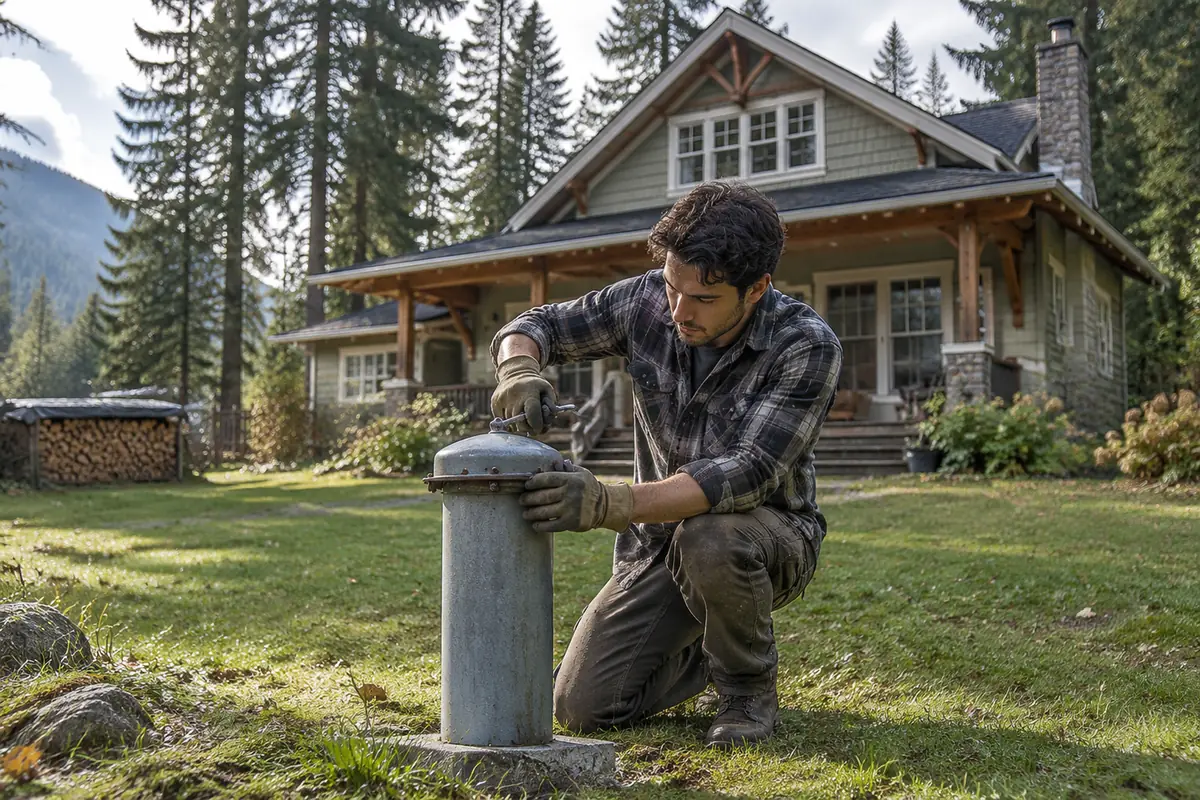
Fraser Health's buyer checklist is quick to do on a first visit. Older dug wells, usually concrete rings less than about 15 m deep, and small driven sandpoints are more likely to have bacteria problems than drilled wells, so note which type you are looking at. Then check for:
- A casing that sticks up 12 to 24 inches above the ground.
- No cracks or holes in the casing.
- A secure, watertight cap.
- Ground that slopes away from the casing so water cannot pond and seep in.
- Septic fields, livestock pens and other contamination sources at least 30 m (100 feet) from the well, on the lot and on the neighbours' lots.
Septic systems: who can work on them
Septic systems in BC fall under the Sewerage System Regulation. Only an authorized person can design, install, repair, maintain or inspect one: a Registered Onsite Wastewater Practitioner, registered through ASTTBC, or a professional engineer. Practitioners can work on Type 1 and Type 2 systems, while Type 3 systems are for professionals only.
When a system is built or altered, the authorized person files a Record of Sewerage System with Fraser Health before work starts, files a Letter of Certification within 30 days of finishing, and gives the owner the plans, a maintenance plan and a copy of the letter. Operating a system with no Letter of Certification on file is an offence, and owners must maintain the system to its maintenance plan and keep records.
| Type | What it means |
|---|---|
| Type 1 | Septic tank and dispersal field |
| Type 2 | Treatment producing effluent under 45 mg/L of suspended solids and 45 mg/L of 5 day BOD |
| Type 3 | Higher treatment: under 10 mg/L of suspended solids and BOD, and a median fecal coliform count under 400 per 100 mL |
Getting the septic records and an inspection
Ask the seller for the plans, maintenance plan, Letter of Certification and pump-out receipts. Fraser Health also takes requests for sewerage system information on a property; the fee is $50 and is not charged if nothing is on file. A search can turn up a permit, a filing, a Letter of Certification, a maintenance plan or an outstanding order, or no record at all, and Fraser Health cannot promise the file holds an accurate diagram. Third party personal information may be removed, so the simplest route is to ask the seller to request it early.
Then hire an authorized person to inspect. Ask them to locate and open the tank, check its condition and components, look over the dispersal field for wet spots or odour, confirm the system suits the house as it stands today, including any suite or added bedrooms, and put it all in writing.
Subjects to put in your offer
Your agent and lawyer will word the clauses, but on a property with a well and a septic system, these subjects protect you:
- A satisfactory potability test from a qualified lab, covering bacteria and chemistry including nitrate, arsenic and manganese.
- A satisfactory well yield test.
- Receipt of the well driller's log or GWELLS record.
- A satisfactory septic inspection by an authorized person.
- Receipt of the septic records and maintenance history.
When I write offers on acreage with a well, I give the water subjects more time than a standard home inspection, because the lab results and the yield test both have to come back inside the subject period. If you are still searching, look at acreage on the Langley side of the valley or rural properties for sale in the Fraser Valley, and read what to check before buying land in BC. If the property is in the ALR, how farm status and ALR rules work is worth a read too.
Frequently asked questions
How often should you test well water in BC?
HealthLink BC recommends testing a private well for bacteria at least once a year, and right away if the water changes in clarity, colour or taste. Chemical testing should be done when the well is finished and then every year. Fraser Health adds a yearly nitrate test in spring or fall.
What should well water be tested for in the Fraser Valley?
Start with total coliform and E. coli bacteria, then nitrate, arsenic and manganese, which are all relevant in this region. Fraser Health notes that nitrate is common in shallow wells in farm areas and that some Fraser Valley groundwater is above the guideline for arsenic.
Where can I get my well water tested in BC?
Use a qualified laboratory. HealthLink BC points to the CALA directory of qualified labs. Most labs do not collect samples themselves; they send a kit with bottles and instructions, or you can hire a professional to take the samples.
Who can inspect a septic system in BC?
Only an authorized person under the Sewerage System Regulation: a Registered Onsite Wastewater Practitioner registered through ASTTBC, or a professional engineer. Practitioners cover Type 1 and Type 2 systems, and Type 3 systems need a professional.
How far should a well be from a septic field?
Fraser Health advises that any source of contamination, including septic fields and livestock pens, should be at least 30 metres (100 feet) from your well. Check your neighbours' lots as well as your own.
Do you need a licence for a household well in BC?
No. Groundwater used only for household purposes does not need a licence, though the Province strongly encourages owners to register their wells for free. Wells drilled, altered or decommissioned after February 29, 2016 must be registered in GWELLS.
Looking at acreage or a home in the Valley?
Shawn can send you current listings and what similar properties have sold for.
See Fraser Valley acreage for saleSources
- Fraser Health: Buying a home with a well
- Fraser Health: Private well owners
- HealthLink BC File 05b: Well water testing
- Fraser Health: Nitrate in well water (March 2021)
- Fraser Health: Arsenic in well water
- Fraser Health: Drinking water safety tips for private well owners
- Fraser Health: What to do after a flood (private drinking water supplies)
- Health Canada: Manganese guideline technical document
- Province of BC: Well records and registration
- Province of BC: Compliance assessment of agricultural practices over 2 sensitive drinking water aquifers
- BC Laws: Sewerage System Regulation, B.C. Reg. 326/2004
- Fraser Health: Sewerage systems, information for property owners (January 2024)
- Fraser Health: Request for sewerage system information form
- Province of BC: Authorized persons under the Sewerage System Regulation
More guides
Buying Land in BC: What to Check Before You Offer on a Fraser Valley Lot or Acreage
A bare lot or acreage gives an inspector almost nothing to look at, so the real checking happens in bylaws, title documents, soil and paperwork. This is the order to work

Farm Status in BC and the Agricultural Land Reserve, Explained
Farm status and the ALR get mixed up constantly, but they are 2 separate systems. BC Assessment decides whether land is classed as a farm for property tax, and the Agricu

Living in Abbotsford BC: Neighbourhoods, Prices and Everyday Life
Abbotsford is the largest city in the Fraser Valley Regional District, with its own airport, a university and a regional hospital, surrounded by farmland. Here is how its